Regenerating Ecosystems,
Cultivating Food,
Harvesting Energy
Regenerating Cultivating Harvesting
0
Years Program
0
Countries
0
Partners
0
Living Labs
The mission of AgriPV-Nexus is to catalyse a sustainable agroecological transition in Mediterranean smallholder farming systems by integrating nature-based, technological, digital, and socio-economic innovations.
By establishing real-world Living Labs in Portugal, Morocco, Tunisia, and Türkiye, the project aims to co-develop climate-resilient, site-specific agroecological practices enhanced by agrivoltaics.
OBJECTIVES
01
Co-developing optimal combinations of agroecological practices
via agrivoltaic LLs: A catalyst for integrated climate-resilient small-scale farming in the Mediterranean.
02
Integrating agroecological practices with agrivoltaics
to demonstrate their climate mitigation, adaptation, and biodiversity co-benefits while advancing the resilience of Mediterranean farming.
03
Demonstrating and quantifying environmental benefits and soil organic carbon (SOC) stock
of integrated agroecological-agrivoltaic farming systems.
04
Develop evidence-based, cross-sectoral policy recommendations
to support the scaling of agroecology, agrivoltaics, and carbon farming across the Mediterranean by aligning national strategies with the WEFE nexus and identifying regulatory, financial, and institutional enablers.
Why Agrivoltaics?
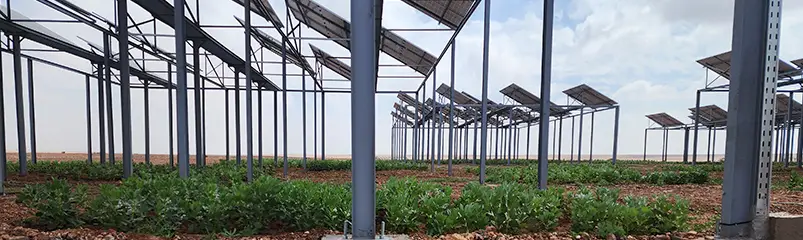
AgriPV-Nexus champions the integration of solar PV systems
In the Mediterranean region, severe shifts in climate are exacerbating water scarcity, soil degradation, and crop vulnerabilities, which directly threatens the socio-economic resilience of smallholder farmers. To combat this, AgriPV-Nexus champions the integration of solar photovoltaic (PV) systems with agroecological practices, a nature-tech solution known as agrivoltaics. These systems offer:
Environmental Co-Benefits
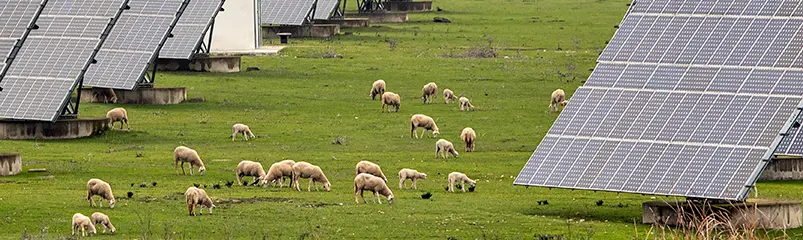
The intentional shading from elevated solar panels creates a moderate microclimate that protects crops from extreme heat, increases soil moisture, and promotes healthier soil conditions.
Water Harvesting
When equipped with collection gutters and nets, agrivoltaic panels can effectively harvest rainwater and fog, drastically improving water-use efficiency in hot, arid environments.
4Living Labs
The AgriPV-Nexus project will assess and validate its approach across diverse Living Labs (LLs) in 4 different Mediterranean countries (Morocco, Portugal, Tunisia, Turkiye). The LLs will take a nature-tech, socio-economic, governance perspective, and adhere to agroecological principles:
LL of UM6P,
Benguerir, Morocco
The LL of UM6P in Benguerir, Morocco, lies in a semi-arid agroecological zone characterized by low and irregular rainfall, high evaporation, and frequent droughts. Soils are predominantly sandy to loamy, with low organic carbon and limited water retention capacity. Agriculture relies on irrigation, often from groundwater. Presently, the agrivoltaic system extends to 0,1 ha, which includes four 14 × 18 m photovoltaic blocks and an adjacent open-field control plot.
LL of ÉUVORA,
Alentejo region, southern Portugal
Alentejo is the most important agricultural region in Portugal, making it particularly interesting for agrivoltaics. Soils are typically low in organic matter. The area faces frequent drought stress and low water availability, making water-use efficiency critical. Traditional farming includes rainfed cereals, olive groves, and extensive livestock, now increasingly combined with agroecological practices. The planned PV system (60kWp) of ÉUVORA’s LL is an overhead system at 4 meters height, the distance between the panel rows is 5 meters. Seasonal crops will be cultivated in a rotating manner.
LL of UNIVGB
south-eastern Tunisia
In an arid to semi-arid Mediterranean climate characterized by high solar radiation, low and irregular rainfall, and high evaporation rates. The LL will be located at the Centre Technique des Cultures Protégées et Géothermiques and includes a 300 m² multi-span greenhouse with a PV system dedicated to protected vegetable production. Currently, the site uses ground-mounted photovoltaic panels for water pumping and to power various measurement and control devices, which will be adjusted within AgriPV-Nexus.
LL of Gedik University,
Havran district, Türkiye
The LL of Istanbul Gedik University is located in Taşarası Village in the Havran district of Balıkesir, Madra Mountains, Türkiye. The Havran district features a Mediterranean climate with diverse agroecological zones, supporting olive groves, vineyards, and forest ecosystems. Its hilly terrain and microclimates foster traditional mixed farming practices, combining dryland crops with small-scale animal husbandry and rich biodiversity. The PV installation for the AgriPV-Nexus LL has been financed under the PRIMA project, no. 2242, FrontAg Nexus.
AgriPV-Nexus
RESULTS
Knowledge Platform
An open-access knowledge sharing and stakeholder capacity building platform tailored for Mediterranean agrivoltaics and agroecology.
Decision Support Tool (DST)
A user-friendly digital tool providing actionable, context-specific recommendations on agrivoltaic-agroecological practices.
Digital Twin of Agrivoltaics-cum-Agroecology System
An advanced virtual model mirroring real-world agrivoltaic-agroecological systems, providing scenario simulations, predictive analytics, and MRV capabilities.
Low-cost Carbon MRV Protocol for Soil Organic Carbon (SOC)
A scalable, affordable protocol for quantifying soil organic carbon in agrivoltaic-agroecological systems.
Policy report & recommendations on agrivoltaics for smallholders
A participatory policy document translating insights from Living Labs into actionable regulatory guidance and business model recommendations.
Newly established Living Labs (LLs)
4 LLs showcase how agrivoltaics and co-developed optimal agroecological practices benefit the surrounding rural communities.
Tested agroecological solutions
5+ tested agroecological solutions under agrivoltatics capable of reducing land and soil degradation.
Explore our latest news
Lorem ipsum